
Eradicating Administrative Burden on National Doctors Day
Eradicating Administrative Burden on National Doctors Day

Updated: Jul 1, 2026, 4:02:20 PM
Text Size:
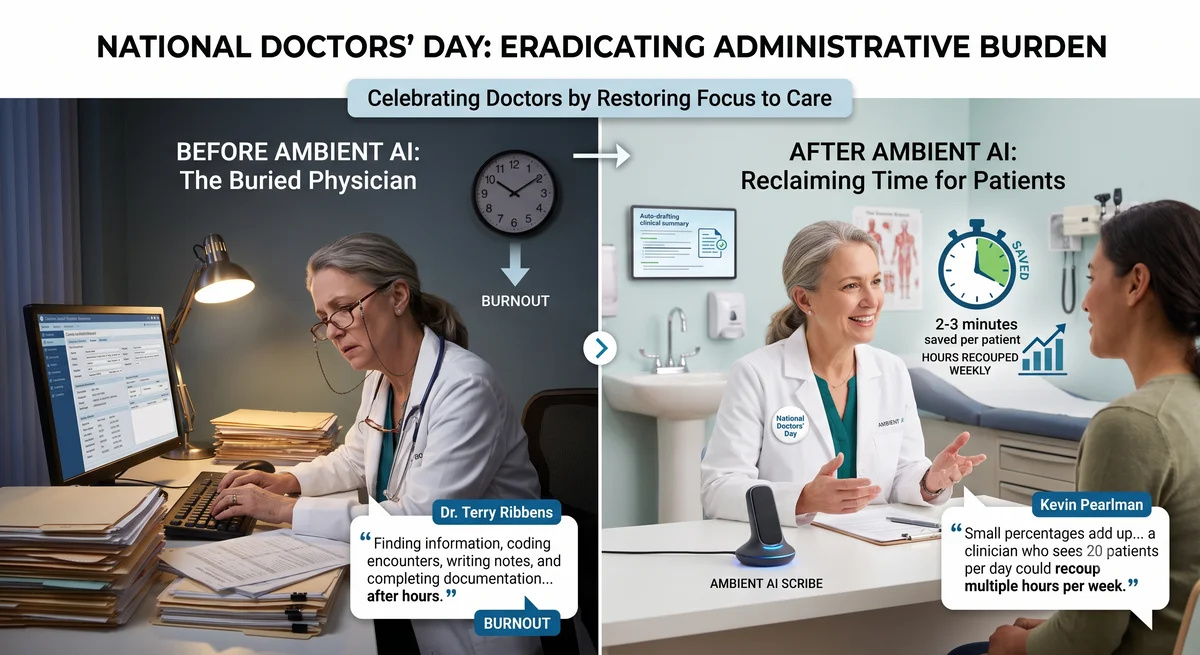
Documenting patient encounters within complex digital records has become the primary driver of operational exhaustion and professional dissatisfaction among modern physicians. Clinicians routinely spend multiple hours navigating administrative software and keying data for every single hour dedicated to direct clinical interactions. This compounding administrative friction has accelerated burnout rates across public and private healthcare infrastructures, directly reducing the time available for meaningful clinical engagement and face-to-face communication. Dr. Terry Ribbens, a practicing family medicine physician and associate Chief Medical Information Officer at St. Luke's Health System, summarized the systemic burden clearly.
"Navigating the EHR, finding information, coding encounters, writing notes and completing documentation all add up – leading to providers completing their administrative work after hours"
To mitigate this systemic crisis, healthcare organizations are rapidly deploying ambient artificial intelligence scribes to capture conversational dialogues and automatically draft structured clinical summaries. On National Doctors' Day, the focus shifts toward evaluating how these digital frameworks alleviate the cognitive task load borne by clinicians. Kevin Pearlman, a clinical informatics fellow, evaluated the compounding time savings that these implementations offer to high-volume outpatient facilities.
"At first glance, an 8.5% reduction in documentation time might seem small, but when you do the math, a clinician who sees 20 patients per day and saves two or three minutes per patient by using an ambient AI scribe could recoup multiple hours per week"
The integration of ambient technology successfully demonstrates how automated workflows can restore the patient-physician relationship by removing physical computer barriers from the examination room. As medical institutions continue to optimize these platforms, the ultimate goal remains the permanent eradication of after-hours charting to preserve the long-term sustainability of the global healthcare workforce.
ALSO READ | Dr. Peter Schwarz Outlines IDF Strategies for Global Diabetes Crisis
ALSO WATCH | Dr V Mohan Outlines Precision Medicine to Subdivide Indian Diabetes
Support TheRightDoctors
A fake news pandemic has taken the world by storm. More so for medical content.
We are witnessing a paradox of information overload and unanswered questions among both the lay public and the medical community.
TheRightDoctors brings you Insights from thought leaders across leading medical specialities. Views which help correct the information asymmetry and articulate the voice of medical science and reason.
This effort, however, needs your support.
Medical journalism is a niche which can survive only when it is adequately funded.
If you appreciate the work we do, we would like to request your support. Every contribution however big or small is valuable to us.
The options on this page enable you to choose between a one-time, monthly or annual payment. This is inclusive of GST. If you are a firm with GST, we will issue a GST invoice. Please reach out to us at support@therightdoctors.com
We thank you for your trust and your support.
SupportTags: Nationaldoctorsday | Ambientai | Physicianburnout | Electronichealthrecords | Healthcareautomation | Clinicaldocumentation | Doctorwellbeing | Medicalworkforce | Healthinformatics | Administrativeburden | Practicemanagement | Digitalhealthindia | Cliniciansatisfaction | Patientcare | Trdfeature | Scribetechnology |
Read More

Most Popular
Dr Chandrashekhar: Image Fat Depot Phenotypes | WCCKMM 2026
The Indispensable Role of SGLT2i in Heart Failure
Incorporating Imaging Refines Risk in CKM Syndrome
Putting AI to Work in Cardiovascular Care
More from TheRightDoctors
Dr. Pankaj Manoria on Post-MI Antiplatelet Therapy Selection
Understanding Systemic Burnout and Policy Initiatives for Doctors

Click here to Register for ECMO course
Trending
Overhauling Medical Curricula: What Doctors Say Must Change
Cardiac MRI Scarring Above 5% Predicts Sudden Death Risk
Food Sequencing & Unpolished Grains Beat Sugar Substitution in CKM
Umbilical Cord LDL of 25 mg/dL is the True Standard: Dr Rajeev Agarwal
Powered by:
.png)
Awards & Recognitions:


